
TL;DR – Quick Summary
Vietnam’s strongest brands in 2026 share common DNA: authentic cultural alignment, digital-first marketing, AI-powered personalization, and community-driven storytelling. Case studies show Grab, Tiki, and local D2C brands scaling through local insights + global execution. AI tools accelerate brand testing, content creation, and customer insights. Companies combining data-driven decisions with emotional storytelling win market share fastest. Vietnam’s e-commerce landscape evolved dramatically—brands must own customer relationships through owned channels while leveraging marketplaces for reach. CreazionMedia helps Vietnam brands replicate these winning strategies.
Table of Contents
1. Why Branding Dominates Vietnam’s Success Stories
2. Case Study #1: Tiki’s Digital-First Dominance
3. Case Study #2: Grab’s Trust-Centered Ecosystem
4. Case Study #3: Local D2C Brands’ Cultural Power
5. AI Tools Transforming Brand Strategy (2026)
6. Digital-First Positioning in Vietnam
7. Content Localization That Converts
8. Omnichannel Brand Strategy for Vietnam
9. 2026 Update: E-Commerce Branding & Marketplace Dynamics
10. FAQ
11. Conclusion & CTA
Introduction
Vietnam’s most successful brands aren’t just selling products—they’re building movements. Tiki isn’t ‘just’ an e-commerce platform; it’s Vietnam’s trusted shopping ecosystem. Grab isn’t ‘just’ a ride service; it’s a lifestyle brand. Local D2C brands aren’t ‘just’ products; they’re statements of Vietnamese identity and values.
The difference? Strategic branding combined with digital excellence.
This 2026 guide analyzes how Vietnam’s strongest brands built market dominance through authentic positioning, digital innovation, and cultural insight. We’ll extract the playbook you can apply to scale your business. Whether you’re a marketplace seller, D2C brand, or tech startup, these principles apply.
Why Branding Dominates Vietnam’s Success Stories
Vietnam’s economy added $100B in GDP from 2024-2026. Much of that growth traces to brands that understood one truth: in a crowded market, brand clarity wins.
Data:
• Brands with strong positioning capture 3x market share of generic competitors
• Vietnamese consumers pay 20-40% premium for trusted brands vs. unknown brands
• 78% of purchases trace to brand recognition, not price comparison
• Companies ranking top-3 in brand awareness in their category control 55%+ market share
• Word-of-mouth (driven by brand strength) accounts for 60% of customer acquisitions
Reason: Vietnam’s middle class (now 45% of population) demands quality AND meaning. They buy brands, not commodities. They buy status, identity, and values alignment—not just functionality.
This is opportunity. Clear branding separates winners from the crowd. Brands winning now aren’t competing on price—they’re competing on positioning, culture fit, and emotional connection.
Lessons: Price-based competition margins compress. Brand-based competition enables premium pricing and loyalty. Vietnam 2026 success requires brand investment, not just product and marketing budget allocation.
Case Study #1: Tiki’s Digital-First Dominance
Tiki became Vietnam’s e-commerce leader not through lowest prices, but through brand trust and cultural alignment.
Strategy:
• Mission Clarity: ‘Make shopping Vietnamese’ (local vendor focus, Vietnamese supply chain emphasis, local founder story)
• Quality Over Volume: Rigorous seller vetting (not every seller admitted), authentic product reviews (incentivize but don’t manipulate), robust buyer protection
• Cultural Alignment: Vietnamese founder, Vietnamese supply chain emphasis, local payment methods support (COD remains 70% of orders)
• Content Strategy: Educational content (how to choose products), seller spotlights (amplify local businesses), customer stories (social proof)
• Community Building: Loyalty program (gamified engagement), social commerce integration (livestreaming), user-generated content (customers create content)
Result 2026: 40M+ monthly users, highest consumer trust score among e-commerce platforms, premium positioning despite intense Shopee/Lazada competition, consistent profitability.
Playbook for you: Identify one trust pillar (quality? speed? authenticity? sustainability?) and own it completely. Build all messaging around that pillar. Reinforce through every customer touchpoint. Don’t try to be everything to everyone.
E-Commerce Branding Strategy explores deeper positioning frameworks.
Key insight: Tiki isn’t winning on price—they’re winning on trust and cultural alignment. Their premium positioning enables better margins and profitability than competitors.
Case Study #2: Grab’s Trust-Centered Ecosystem
Grab started as a ride-sharing app. By 2026, it’s Vietnam’s largest ecosystem brand, with payments, food delivery, logistics, and financial services.
Branding strategy:
• Super-Ecosystem Positioning: Transform from ‘ride app’ to ‘your everything app.’ Single trusted partner for multiple needs.
• Trust Foundation: Safety innovations (panic buttons, driver verification, real-time tracking), transparent pricing, reliable service.
• Driver-Centric Messaging: ‘Grab cares about drivers’ becomes driver loyalty + word-of-mouth advocacy. Drivers are brand ambassadors.
• Social Impact Messaging: Driver opportunities created, women’s safety programs, environmental commitments, community development.
• Hyper-Localization: Marketing differs by region. Hanoi messaging differs from Ho Chi Minh City differs from Da Nang. Regional insights matter.
Result 2026: 80%+ wallet share among app-using Vietnamese, expanded into 8+ categories, cultural icon status (Grab references common in everyday conversation), valued at $20B+.
Playbook for you: If you offer multiple products/services, unify under one master brand promise. Build dominance in one category first (proven trust), then expand. Don’t diversify before you dominate.
Multi-Category Brand Strategy provides tactical steps for ecosystem brands.
Key insight: Grab won through trust, not innovation. Many ride-app competitors existed. Grab dominated through consistent, reliable service and deeper cultural integration.
Case Study #3: Local D2C Brands’ Cultural Power
Vietnamese D2C brands (fashion, beauty, home, food) scale rapidly by combining global aesthetics with deep cultural roots.
Winning D2C brands:
• Mahalo (Vietnamese fashion): Celebrates Vietnamese craftsmanship, supports local artisans, sustainability-focused. Brand positioning: ‘Wear Vietnamese heritage.’
• Huỳnh Gia (cosmetics): Rooted in Vietnamese botanicals, Gen Z sustainability values, transparent supply chain. Brand positioning: ‘Beauty from Vietnam’s nature.’
• Na Organic (nutrition): Authentic Vietnamese founder story, family recipes modernized for Gen Z, health-focused. Brand positioning: ‘Traditional wisdom, modern science.’
Common winning playbook:
1. Founder Story: Authentic personal origin tied to Vietnamese identity (not random foreign brand using Vietnamese aesthetics)
2. Product Philosophy: Values-driven (sustainability, local community support, tradition respect)
3. Digital Strategy: TikTok/Instagram native, user-generated content, micro-influencer partnerships
4. Customer Community: Discord servers, WhatsApp groups, customer councils. Transform customers into community.
5. Transparency: Share supply chain origins, show production process, humanize brand through founder presence
Result: These brands grow faster despite lower marketing budgets than corporate competitors. Authentic community beats expensive advertising every time. Customer acquisition cost 40-60% lower than traditional brands.
Playbook for you: D2C Branding Strategy reveals how to build founder-centric, community-driven brands.
Key insight: Local D2C brands winning aren’t cheaper—they’re more authentic. Premium positioning enabled by authentic founder story and cultural alignment, not price competition.
AI Tools Transforming Brand Strategy (2026)
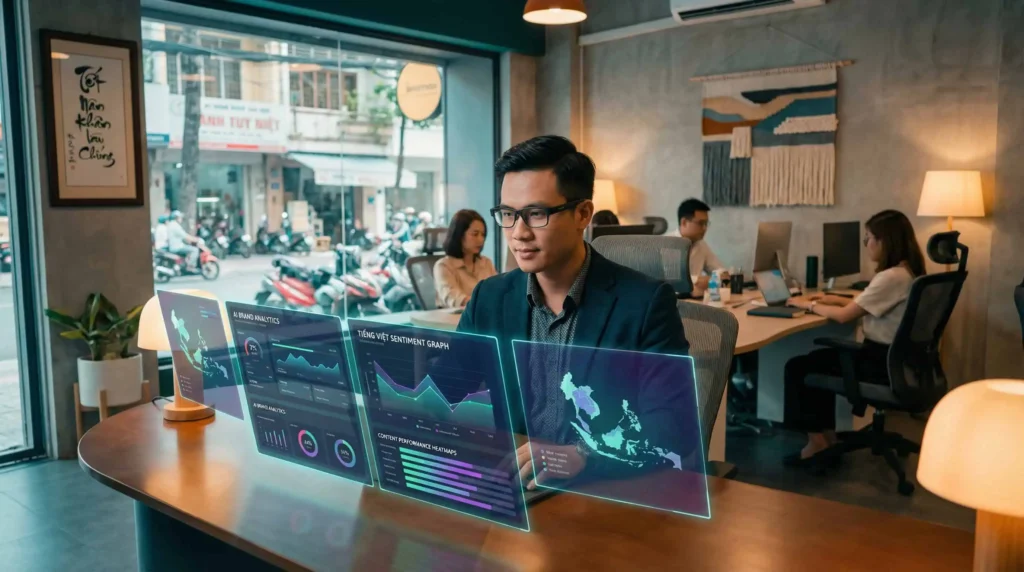
Vietnam’s fastest-growing brands leverage AI for competitive advantage:
• Brand Positioning AI: ChatGPT, Claude generate positioning variations, test messaging frameworks, conduct competitive analysis in hours instead of weeks. Start with 20 positioning options, test top 5 with customers, refine winners.
• Customer Sentiment Analysis: AI analyzes social media, reviews, competitor comments to reveal brand perception shifts in real-time. Identify sentiment trends before they become crises.
• Content Generation: Jasper, Copy.ai, Surfer SEO auto-generate brand content (blog posts, social captions, email) while maintaining voice consistency. 10x content production velocity.
• Predictive Analytics: AI forecasts which brand messages, visuals, campaigns will perform before launch. Test messaging with small budget, scale winners.
• Personalization: AI segments audiences by intent, delivers personalized brand experiences, tracks brand perception at individual level. Same brand message doesn’t work for everyone.
• Design Iteration: Canva AI, Design2Web automatically create variations of brand assets (social templates, landing pages, ads). Test visual variations quickly.
Trend 2026: Vietnam brands using AI-assisted strategy (faster iteration, data-backed decisions) + human-centered storytelling (cultural nuance, authenticity) dominate. Pure AI-generated content feels generic. Pure intuition moves slowly. Combination wins.
Implementation: Start with 1-2 AI tools. Build workflows. Measure. Scale. AI Tools for Brand Strategy details specific tools & workflows.
Warning: AI tools accelerate execution but don’t replace strategy. Human insight—especially cultural understanding of Vietnam—remains irreplaceable. Use AI for speed, humans for wisdom.
Digital-First Positioning in Vietnam
Vietnam has 75M+ internet users (2026). Digital-first positioning isn’t optional—it’s table stakes.
Digital-First means:
• Brand experience optimized for mobile first, not desktop-first. 95% of Vietnam users access internet via mobile.
• Social commerce integration (Instagram Shops, TikTok Shops, Facebook Marketplace). Where customers spend time = where you sell.
• Omnichannel presence (app, website, social, marketplace, physical store coherent experience). Customers expect seamless experience across channels.
• Real-time customer engagement (chatbots, community management, livestream commerce). Speed matters—respond within hours, not days.
• Data collection & personalization (respecting privacy, especially post-iOS changes).
Winning Vietnam brands treat digital as primary channel, physical as secondary. This flips 10-year-old playbooks.
Example: Luxury brands that thrived in malls are losing to digital-first competitors. Established retail brands are becoming e-commerce brands with physical showrooms (brand experience centers, not traditional retail).
Playbook: Audit your current digital presence. Is your brand optimized for mobile? Social? Marketplace? If not, restructure immediately. Digital positioning is your foundation. Digital-First Brand Strategy shows implementation roadmap.
Content Localization That Converts
Vietnam isn’t one market. Northern, Southern, Central regions have different dialects, values, media consumption, and purchasing behaviors.
Localization tactics:
• Dialect Awareness: Don’t use generic Vietnamese. Northern dialect emphasizes traditional wisdom. Southern emphasizes entrepreneurship and progress. Central balances both. Use authentic regional language.
• Regional Values: North prioritizes tradition & family. South prioritizes opportunity & individual progress. Center balances both. Tailor messaging accordingly.
• Media Preferences: TikTok dominates Gen Z (18-25). Facebook still strong with 35+. YouTube emerging for tutorials & aspirational content. YouTube Shorts growing fast.
• Festival Marketing: Tet, Mid-Autumn Festival, National Day create brand moments. Each region celebrates slightly differently. Create regional variations.
• Influencer Mix: Partner with national mega-influencers (3M+ followers, lower engagement but broad reach) + regional micro-influencers (100K-1M followers, high engagement, deep local credibility). Combination beats one approach.
Content Localization Strategy provides detailed regional playbook.
Implementation: Before launching nationwide campaign, test regional variations. Measure engagement. Scale winning variations. This approach increases ROI 30-50% vs. one-size-fits-all campaigns.
Omnichannel Brand Strategy for Vietnam
Vietnam’s strongest brands in 2026 operate omnichannel—presence everywhere customers spend time, consistent brand experience across channels.
Channels to consider:
• Website: Owned channel, full control, direct customer relationships. This is your foundation.
• Mobile App: Download barrier but higher engagement. Push notifications, loyalty integration, exclusive features.
• Marketplace (Tiki, Shopee, Lazada): Reach (40M+ monthly users) but less control over brand experience and customer relationship.
• Social Commerce (TikTok Shop, Instagram Shop): Fast-growing, impulse purchase friendly, younger demographics.
• Physical Stores/Showrooms: Experience center, builds brand presence, local community integration (even if you don’t sell here).
• Livestream Commerce: 60% of e-commerce sales now include livestream element. Partner with influencers or host yourself.
Strategy: Own your customer relationship through owned channels (website, app, email). Use marketplaces/social commerce for reach and discovery. Use physical for brand experience and community integration.
Brand consistency: Same brand messaging, visuals, voice across all channels. Same product pricing (or explain premium/discount). Same customer service standards. Customers switch between channels—experience should be seamless.
Key metrics: Track customer journey across channels. What percentage discover on social, research on website, buy on marketplace? Optimize this journey.
2026 Update: E-Commerce Branding & Marketplace Dynamics
E-commerce branding evolved dramatically 2024-2026:
• Marketplace Saturation: Tiki, Shopee, Lazada, Sendo created commoditized platform competition. Brands must differentiate not just on marketplace, but across owned channels. Marketplace alone insufficient.
• Live Shopping Dominance: 60% of e-commerce sales now include live streaming element (product demo, limited-time deals, influencer endorsement). Brands need livestream strategy.
• Community Commerce: Closed-group buying (group chats, Discord servers, private Facebook Groups) drives 25% of D2C sales. Brands building private communities outpace marketplace-only players.
• Sustainability Credentials: Gen Z (40% of buyers) prioritize eco-friendly branding. Packaging, supply chain transparency, carbon footprint communication matter for brand selection.
• Cross-Border Integration: Vietnam brands expanding to Thailand, Philippines, Indonesia succeed by adapting branding for each market while maintaining core identity. Regional positioning increasingly important.
• Creator Economy: 70% of Gen Z trust influencer recommendations over brand advertising. Creator partnerships central to brand strategy.
Trend: Marketplace presence necessary but insufficient. Winning brands own customer relationships through owned channels (email, app, community), use marketplace for reach, and maintain brand control everywhere. This enables better margins, direct customer insights, and brand loyalty.
Implementation: Build owned channel first (website/app). Then expand to marketplace for reach. Don’t reverse this sequence.
Frequently Asked Questions
Quick answers to common questions
Can small brands compete with Tiki/Grab in brand dominance?
Absolutely. Tiki/Grab dominate categories but ‘own’ only certain value propositions. Niche brands win by owning different values (sustainability, craftsmanship, local artisan, female-founded, etc.). Build positioning adjacent to their strengths, not head-to-head with market leaders.
How important is founder story vs. product quality in Vietnam branding?
Both critical. Vietnam’s D2C winners succeed through authentic founder-product alignment. Product must deliver on promises. Founder story must resonate emotionally. Neither alone wins—combination wins.
Should Vietnam brands target diaspora or domestic market first?
Domestic first. Build brand strength locally (mastery of market nuances), then expand diaspora. Diaspora audiences smaller but higher-value. Can’t support both simultaneously as startup.
How do I use AI without losing authentic brand voice?
Use AI for analysis, ideation, content drafting. Use humans for strategy, voice refinement, final approval. AI 60% → human 40% workflow maintains authenticity + speed.
Conclusion & CTA
Vietnam’s strongest brands aren’t the oldest or richest. They’re clearest about who they are and what they stand for. They combine cultural insight with digital sophistication. They leverage AI for efficiency without sacrificing authenticity.
They win by being intentional about branding every single day—every customer touchpoint, every message, every experience.
Your brand isn’t your logo or tagline. Your brand is the promise you make and keep. It’s the feeling customers have when they interact with you. It’s why they choose you over competitors.
Ready to build a brand that dominates Vietnam’s market?
Book a free brand audit at creazionmedia.com. Our Vietnam branding specialists will analyze your current positioning, benchmark against winning competitors, and reveal the exact strategy to claim market leadership. Let’s build the brand Vietnam can’t ignore.
Your 2026 brand momentum starts now.