
KPI Snapshot
Industry
Industrial / Manufacturing
Service
SEO Growth Strategy
Region
India
Timeline
8 months
Primary Outcome
+12,900% impressions growth
Secondary Outcome
+6,500% keywords | +690% traffic
This SEO growth case study breaks down how CreazionMedia built a scalable, system-driven SEO engine that transformed a low-visibility industrial website into a globally discoverable asset. The objective was not cosmetic SEO, but structural dominance—technical clarity, keyword intelligence, internal linking, and international expansion designed to compound over time.
This case study is intentionally SEO-centric, not industry-centric. While the client operated in the industrial and manufacturing ecosystem, the framework, systems, and outcomes documented below apply to any brand that depends on organic visibility for long-term growth.
The SEO Problem (Before CreazionMedia)
Before engagement, the website suffered from foundational SEO failures that prevented any meaningful ranking or scale:
- Fragmented website architecture with no crawl hierarchy
- Near-zero keyword footprint in commercially viable queries
- No internal linking system or topical clusters
- Weak technical health affecting indexation and crawl depth
- No GEO or international SEO signals
- Content created without search intent or keyword mapping
Search engines had no reason to trust, rank, or expand the site’s visibility.
The SEO Strategy Framework We Deployed
Rather than applying surface-level optimisations, we rebuilt the site as a search engine–first system.
1. Full Technical SEO & Architecture Rebuild
- Reconstructed the entire information architecture
- Cleaned and consolidated outdated and duplicate pages
- Corrected indexation, crawl depth, and URL structure
- Optimised headers, metadata, and page hierarchy
- Implemented structured data to improve semantic clarity
The site was rebuilt to be crawl-efficient, indexable, and scalable.
2. Keyword Intelligence & Content Cluster Engineering (AEO + GEO
We mapped 300+ keywords across intent layers:
- Informational (guides, explainers)
- Commercial (comparison, evaluation)
- Product and buyer-intent queries
- Long-tail and technical search terms
Instead of chasing isolated keywords, we built interconnected content clusters designed to establish topical authority.
This structure allowed search engines to understand depth, relevance, and expertise—not just relevance to a single term.
3. Advanced Internal Linking System
- Built hub-and-spoke content architecture
- Linked informational pages to commercial and product pages
- Reduced average click depth across the site
- Distributed authority across priority URLs
Internal linking became a ranking accelerator rather than an afterthought.
4. On-Page SEO & Schema Implementation
- Semantic keyword placement across headings and body content
- H1–H2 hierarchy clean-up for intent clarity
- FAQ, Product, and Page-level schema deployment
- Optimised meta titles and descriptions for CTR and relevance
This ensured the content was optimised for both users and AI-driven search systems.
5. GEO & International SEO Expansion
- Country-level audience targeting
- International visibility across 25+ countries
- Optimisation for region-agnostic industrial queries
- Search footprint expansion without paid acquisition
The site transitioned from local visibility to global discoverability.
The strategy was aligned with Google’s best practices for sustainable SEO growth as outlined in official search documentation.
Example Keyword Clusters Ranked (Proof of Execution)
These are representative keyword clusters used to demonstrate execution depth—not ranking targets for this website:
| SEO Cluster Type | Example Keywords Ranked |
|---|---|
| Product-Led SEO | Parts of scaffolding, scaffolding clamp |
| Informational SEO | Materials of scaffolding, cantilever scaffolding |
| Long-Tail SEO | Scaffolding parts name, scaffolding pieces |
The success of these clusters validated the structural SEO approach rather than reliance on individual keywords.
SEO Results Achieved
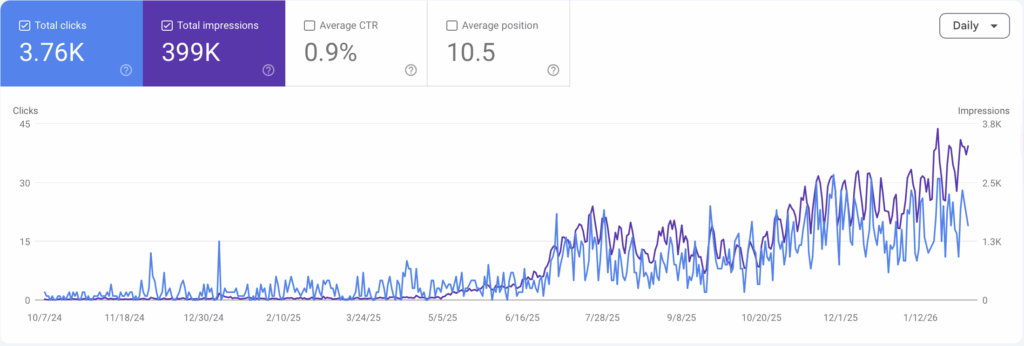
Within eight months of implementation, the SEO system delivered compounding growth:
- Organic impressions grew from 618 to 80,000+ per month
- Ranking keywords increased from 5 to 333+
- Monthly organic traffic scaled from 49 to 386+
- GEO reach expanded from 3 countries to 25+ countries
- 80+ technical SEO issues resolved
- On-page SEO score improved to 99/100
When SEO execution stopped, performance declined—validating that the growth was system-driven, not coincidental.
Why This SEO Model Works Across Industries
This case study proves a critical truth: SEO growth is not industry-dependent—it is structure-dependent.
Industrial websites are inherently complex. Ranking in such environments requires:
- Deep content architecture
- High technical discipline
- Strong internal linking logic
- Intent-based keyword mapping
If this SEO framework can scale visibility in a technically dense industry, it translates even more efficiently to SaaS, B2B services, enterprise platforms, and global brands.
Who This SEO Strategy Is Built For
This SEO framework is designed for:
- B2B and enterprise businesses
- Industrial and manufacturing brands
- SaaS platforms with complex offerings
- Global companies expanding across regions
- Businesses stuck after generic or blog-only SEO
If your SEO efforts aren’t compounding, the issue isn’t content volume—it’s system design.
Next Steps
If you’re looking for SEO that compounds over time—built on architecture, intent, and authority rather than vanity metrics—this is the framework we deploy.
Book a strategic SEO consultation to evaluate whether your site is built to scale.